

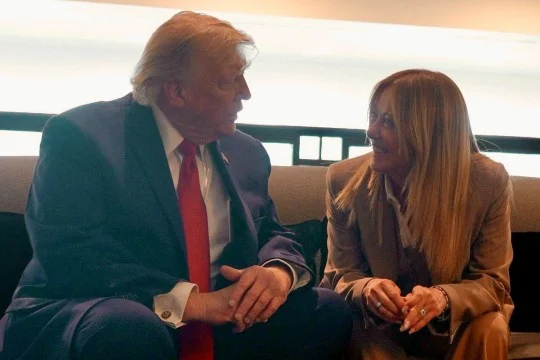
ROME — As world leaders gathered for the latest G7 summit, Italian Prime Minister Giorgia Meloni arrived with a clear message: Italy intends to defend its national interests while remaining a central player in Western alliances.
Throughout the summit, Meloni positioned herself as both a committed partner and an independent voice — a balancing act that increasingly defines Italy’s role on the global stage.
For supporters, the message was simple: Italy didn’t fold.
A Different Tone at the G7
The latest G7 meeting was dominated by discussions surrounding trade tensions, artificial intelligence, geopolitical instability, and the future of global economic cooperation.
While leaders publicly emphasized unity, important disagreements emerged behind closed doors.
Trade policy, industrial competition, migration, and economic sovereignty all became subjects of intense negotiation.
Against this backdrop, Meloni repeatedly argued that European countries must remain competitive while preserving their ability to make sovereign decisions.
Observers noted that Italy often sought compromise without abandoning its own priorities.
Meloni’s Balancing Strategy
Since taking office, Meloni has attempted to pursue a strategy that combines strong support for Western institutions with a more assertive defense of Italian interests.
This approach was visible throughout the summit.
Italy continued supporting NATO commitments and cooperation with allies while also pushing for greater flexibility on issues including:
- Industrial policy.
- Migration.
- European fiscal rules.
- Energy security.
- Trade competitiveness.
Political analysts say Meloni’s strategy reflects broader changes occurring across Europe.
Many governments are increasingly seeking to balance international cooperation with domestic political pressures.
Trade Tensions Move to Center Stage
One of the most important discussions at the summit involved trade.
Growing concerns about tariffs, industrial subsidies, and economic competition created visible tensions among allies.
Several countries expressed concerns regarding the long-term impact of protectionist policies on global growth.
Italy, whose economy depends heavily on exports and manufacturing, has a significant stake in the outcome.
Italian officials emphasized the importance of maintaining open markets while protecting strategic industries.
This balancing act has become increasingly difficult as geopolitical competition intensifies.
Europe’s Political Landscape Is Changing
The G7 summit highlighted a broader political transformation taking place across Europe.
Voters in many countries are demanding stronger national leadership, greater economic security, and more control over migration and industrial policy.
As a result, governments are increasingly adopting more assertive positions during international negotiations.
Italy’s current leadership reflects this trend.
Supporters argue that Rome is simply defending national interests more confidently.
Critics worry that excessive fragmentation could weaken European unity.
The Question of Sovereignty
Perhaps the most important theme emerging from the summit was sovereignty.
Who should shape economic policy?
How much authority should remain at the national level?
How should governments balance global cooperation with domestic priorities?
These questions increasingly define political debates throughout Europe.
Meloni’s position suggests that future European politics may involve deeper cooperation in some areas and greater national autonomy in others.
A Changing Global Order
The latest G7 discussions demonstrated that the international system itself may be entering a period of transition.
Trade disputes, technological competition, energy security concerns, and geopolitical tensions are reshaping relationships among allies.
Many analysts believe the world is moving away from the highly globalized model that dominated previous decades.
Economic security and strategic autonomy are becoming increasingly important.
In this environment, countries are seeking partnerships without sacrificing flexibility.
Italy appears determined to do exactly that.
Looking Ahead
The latest G7 summit showed that Italy intends to remain an influential voice within Europe and the broader Western alliance.
Under Giorgia Meloni, Rome is attempting to navigate an increasingly complex world by combining cooperation with national assertiveness.
Whether this strategy succeeds remains uncertain.
But one message from the summit was clear:
Italy is willing to negotiate.
Italy is willing to cooperate.
Yet Italy does not intend to simply follow.
As global politics enters a new phase, Rome is making it known that Italy didn’t fold.